Watch Schools · Case Study · Jo Siffert
The Stuntman's
Stuntman
Hollywood Illusions & Trunk-Deal Chronographs · Jo Siffert & the Heuer Autavia
In an era when circuit racing was banned in Switzerland after the 1955 Le Mans disaster, a teenage farm boy from Fribourg raced illegally on public roads, dodging police chases with the same instinctive feel for the limit that would later define his career. They never caught him. He won the Swiss 350 cc championship in 1959 on a Gilera, then threw himself into sidecar racing where he would hang over the side as a human counterweight at speeds over 140 mph.
Jo Siffert lived life perpetually "late on 200 mph" — a self-funded motorsports privateer deep in debt who raced an open-wheel BRM in Formula 1 on Sunday, immediately flew to wrestle the 600-horsepower Porsche 917 in endurance events like Le Mans or Spa, then crossed the Atlantic to muscle the monstrous 917/10 in Can-Am, all while squeezing in Formula 2 races to fill the gaps. He would do anything to shave off even a tenth — timing fuel windows and braking points with watchmaker precision.
Siffert's great breakthrough came at Brands Hatch in 1968. Completely self-funded and deep in debt, the ultimate privateer had everything riding on that single race — no factory team, no spare parts truck, no safety net, only his own Lotus 49. In the pouring rain, while every factory squad dove for wet tyres, Siffert stayed out on slicks, pushing the car to the absolute limit.
In one breathtaking move at Paddock Hill Bend, he sliced past Graham Hill and Jackie Stewart, then held the lead to take the chequered flag — the first true privateer to topple the factory machines. Still soaked and grinning, he lit a cigarette and delivered the perfect line:
I just drove it like it was my own car — because it was.
Jo Siffert · Brands Hatch · 1968
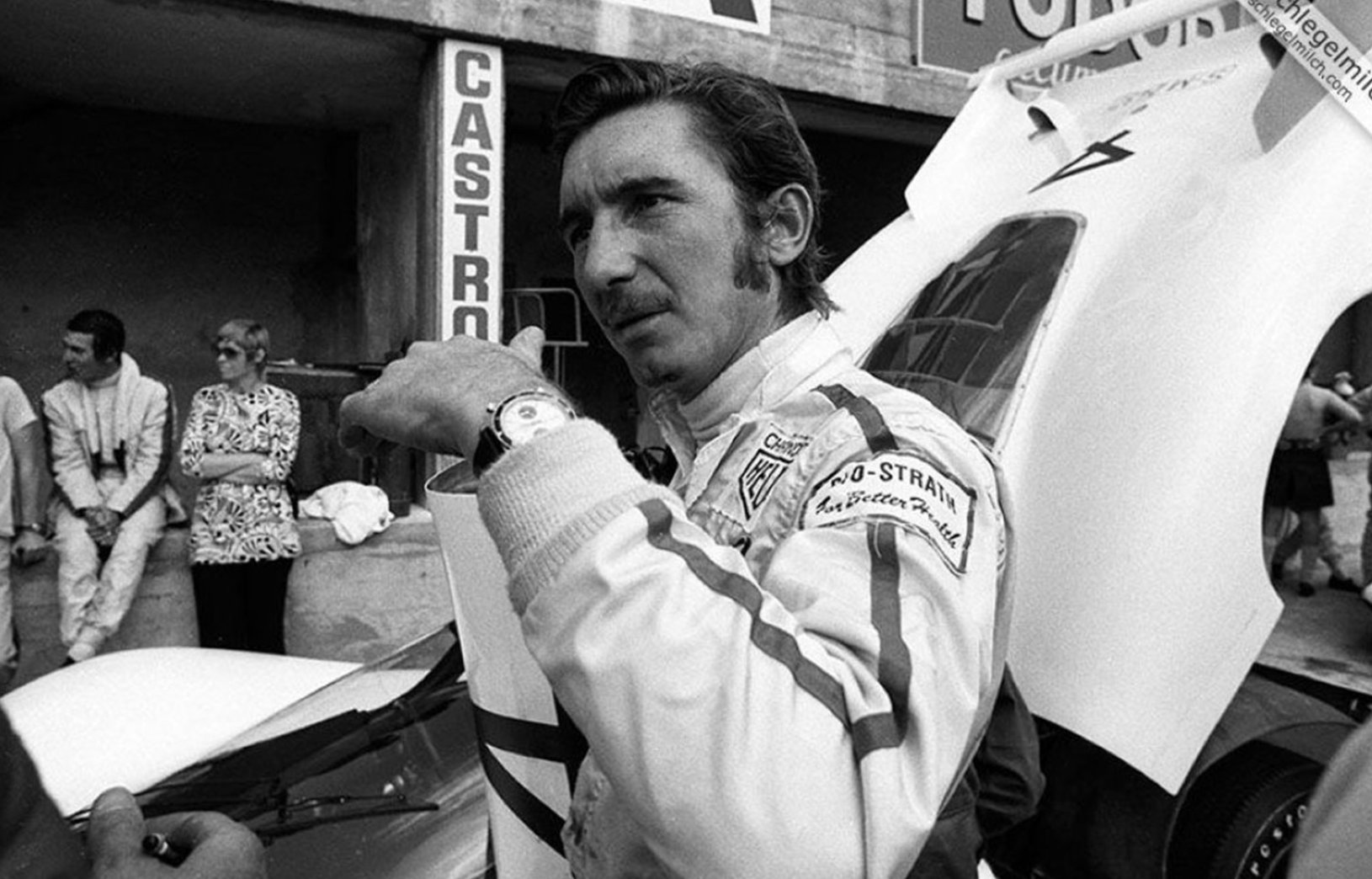
That same year, at his local golf club, Jack Heuer was approached by a mutual friend from Fribourg who mentioned a hungry young Swiss privateer. Heuer drove straight to Siffert's Porsche dealership. Within minutes Siffert had sold him a 911 and struck the first modern watch-motorsport sponsorship: Heuer logo on suit and car.
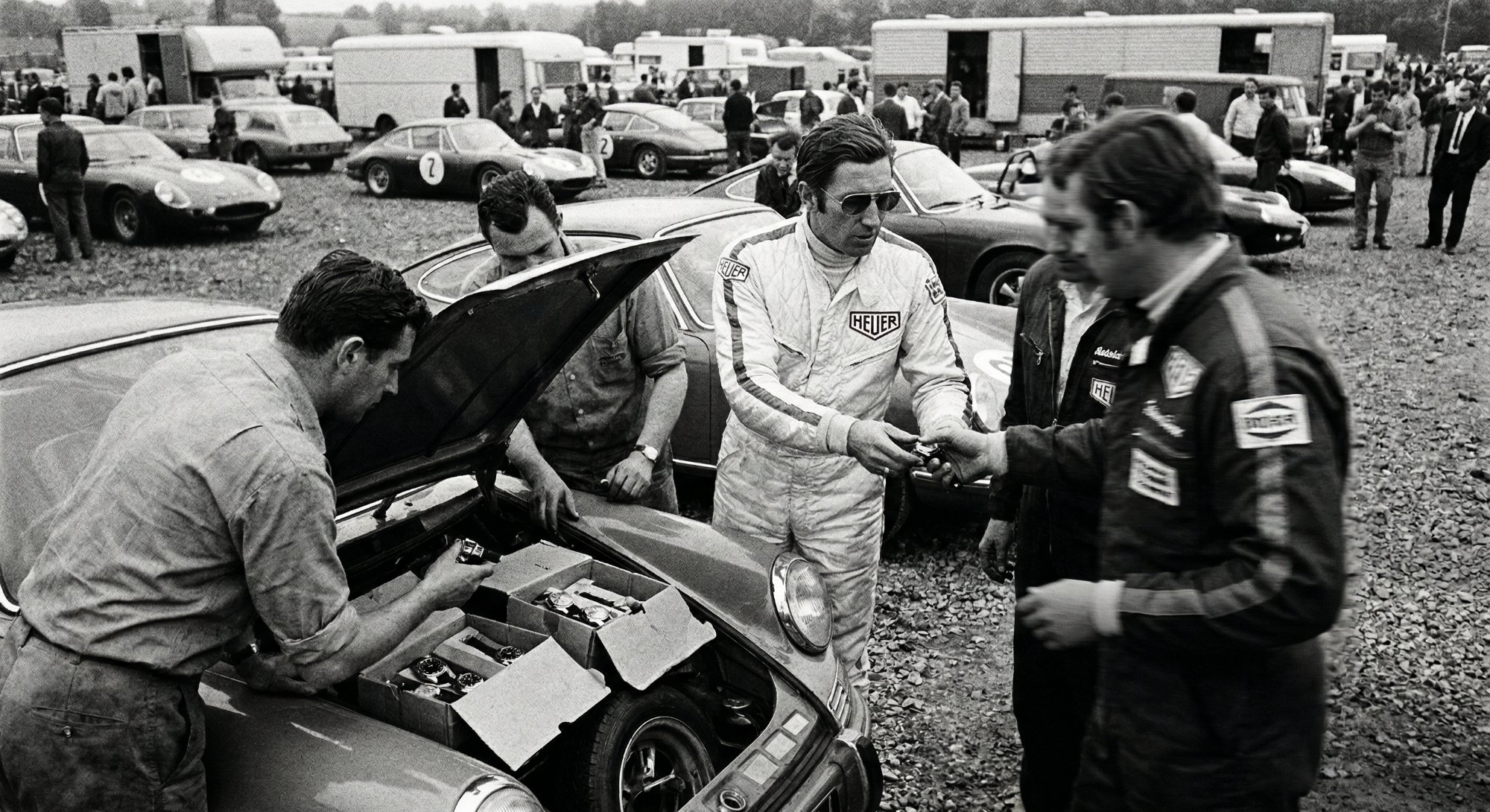
Jo being Jo, he saw an angle. He asked me, 'Jack, can I buy your watches at wholesale prices?' I said yes. What I didn't realise was that between practice sessions, Jo was opening the trunk of his Porsche and selling our chronographs to the other drivers, team managers, and mechanics at retail prices. He single-handedly equipped half the Formula 1 grid with Autavias and Carreras just to make a side profit.
Jack Heuer · CEO, Heuer SA
What began as a modest handshake became one of the most effective marketing moves in horological history. Siffert turned the paddock into his personal showroom, using the Autavia on his own wrist as both tool and working capital.
During the filming of Le Mans, Siffert was brought on as both stunt driver and role model for authenticity. Steve McQueen studied him like a blueprint — looked out at the track, pointed straight at Siffert in his white Gulf suit with the Heuer logo, and said: "I want to look exactly like Jo."
He copied Siffert's exact suit — Heuer patch included — and chose the square-cased Monaco chronograph to match the privateer's avant-garde style. Siffert performed the high-speed stunts McQueen was barred from. After one practice crash he climbed out, dusted himself off, casually lit a cigarette, handed McQueen the Autavia from his wrist and said: "See? Still ticking." McQueen later used that exact gesture in the film.
But the absolute, unforgiving reality of living at 200 mph is that the machine eventually demands a reckoning. Siffert wasn't just the stunt driver for Le Mans — he was the stuntman's stuntman. McQueen was universally worshipped as the "King of Cool", but McQueen knew he was operating with a safety net. Siffert was the actual iconoclast.
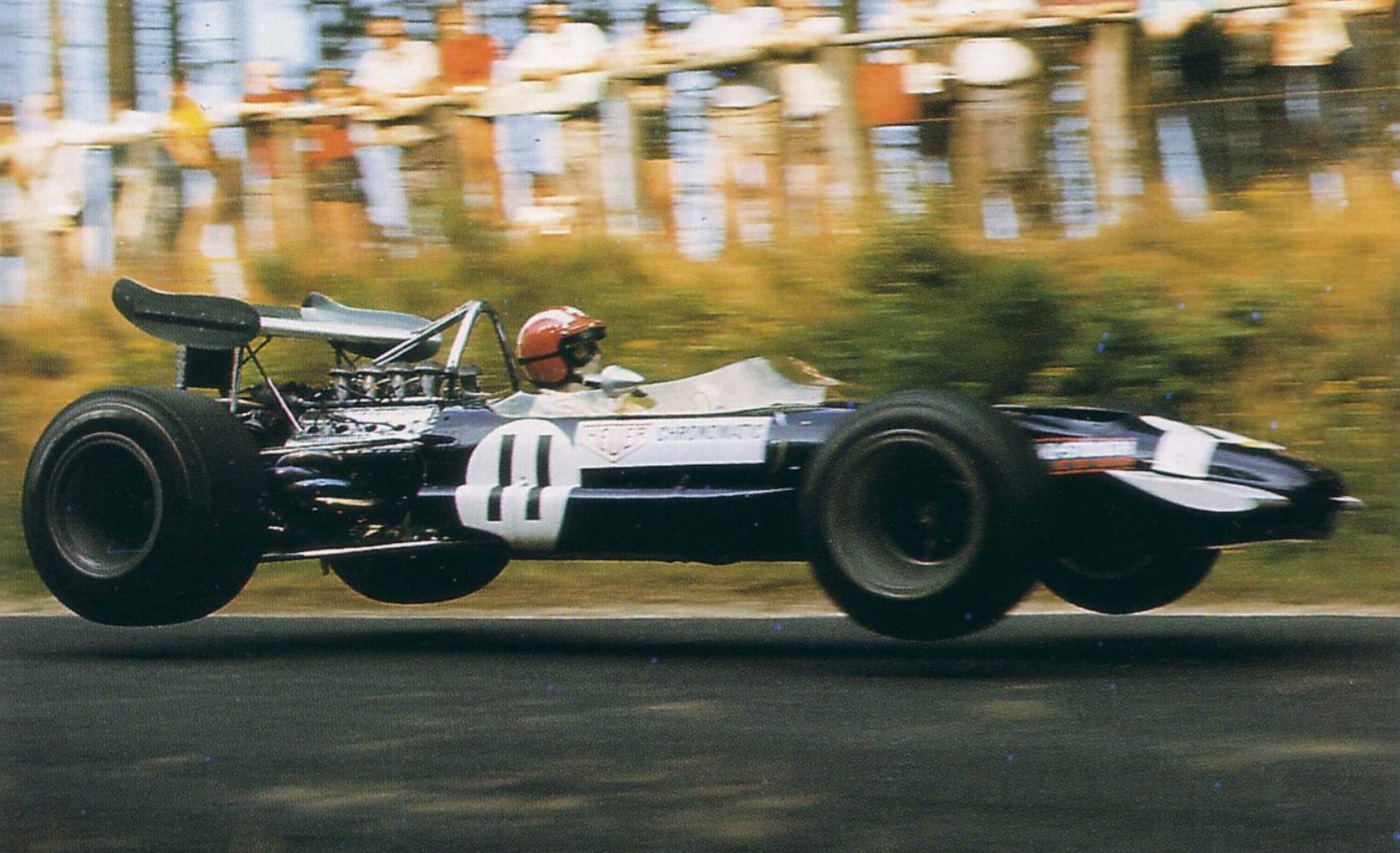
On October 24, 1971, at a non-championship exhibition race at Brands Hatch — the very track where he had achieved his greatest privateer triumph — a mechanical failure threw Siffert's BRM off the circuit. The car rolled and burst into flames. He survived the impact. He died of asphyxiation when the track's fire extinguishers failed.
The legacy of Siffert's death perfectly frames a bitter irony of the modern vintage watch market.
Why does the watch worn by the actor sell for a massive multiple of the watch worn by the operator? It exposes the exact fault line between Hollywood hype and horological reality. The market pays a colossal "King of Cool" premium for the simulacra — the movie poster, the celebrity myth, the illusion of danger.
McQueen created a pristine, $2.2 million auction "Excalibur" by dramatically gifting his watch to a mechanic at the end of filming, creating a perfect chain of custody. Siffert, the relentless hustler, actively destroyed his own provenance. Because he treated his Autavias as liquid capital — literally selling them off his wrist to rival mechanics to fund his next race — he flooded the paddock. He didn't care about creating a multi-million-dollar museum piece; he cared about buying spark plugs for Sunday.
What is the true value of the battered watches that Siffert actually wore, raced in, and gave away to survive?